
Sorting tax as a freelancer can feel confusing, especially when every pound earned comes directly from your clients and nothing is handled through payroll. Many British freelancers run their own business and must track income, claim expenses, and file their own returns with HMRC. This guide clears up the rules around freelance income tax, highlighting what counts as earnings, how to register, and exactly which steps make tax filing simple and stress-free.
Table of Contents
- Defining Freelance Income Tax in The UK
- Which Income Counts as Freelance Earnings
- How Income Tax for Freelancers Works
- Filing Your Tax Return With HMRC
- Common Pitfalls and Mistakes to Avoid
Key Takeaways
| Point | Details |
|---|---|
| Freelancer Tax Responsibility | As a freelancer, you are completely responsible for managing your own tax, including registration, income tracking, and filing. |
| Understanding Taxable Income | Know which earnings count as taxable income and ensure all freelance payments are reported accurately to avoid fines. |
| Record Keeping is Essential | Maintain organised records of income and expenses to facilitate accurate filings and prevent last-minute stress. |
| Avoid Common Mistakes | Familiarise yourself with frequent errors, such as underreporting income or claiming disallowable expenses, to safeguard against penalties. |
Defining Freelance Income Tax in the UK
Freelance income tax in the UK is the tax you pay on money earned from self-employment. It’s different from the tax paid by employees, which is handled automatically through PAYE (Pay As You Earn). As a freelancer, you’re responsible for calculating, reporting, and paying this tax yourself.
The key distinction is that self-employed workers run their own business and are responsible for its success or failure. You’re not employed by a client; instead, you work under a contract for services, submit invoices, and manage your own tax obligations. HMRC decides your tax status based on how you work, not what you call yourself.
Freelancing means flexibility, but it also means tax responsibility. Here’s what this actually involves:
- You receive income directly from clients rather than through payroll
- You must register as self-employed with HMRC
- You complete an annual Self Assessment tax return
- You pay Income Tax and National Insurance contributions
- You keep records of all income and business expenses
How Freelance Income Works
Freelancers work for multiple clients on a flexible basis, taking on projects as they come. Your income varies month to month, which affects how you manage tax throughout the year.
You might earn £500 one month and £2,500 the next. This unpredictability means you need a system to track earnings accurately. Unlike employees who receive consistent paycheques, freelancers must set aside money for tax bills that arrive later.

Your taxable income is what remains after you deduct allowable business expenses. These might include office supplies, software subscriptions, professional insurance, or a portion of your home office costs. The more legitimate expenses you claim, the lower your taxable income becomes.
Why It Matters
Understanding freelance income tax helps you avoid penalties and surprise bills. Filing incorrectly can result in fines from HMRC. More importantly, knowing the rules means you keep more of what you earn by claiming every legitimate expense.
Many freelancers underpay because they don’t grasp how much tax they’ll owe. By understanding the basics now, you can plan ahead and avoid financial stress when the tax bill arrives.
Self-employment tax responsibility falls entirely on you, not a payroll department. You must register, track income, claim expenses, and submit returns on time.
Pro tip: Start tracking your income and expenses from your first freelance payment, not when you file your tax return—this makes accuracy much easier and reduces stress at year-end.
Which Income Counts as Freelance Earnings
Not every pound you receive counts as taxable freelance income. Understanding what HMRC considers earnings from self-employment is crucial for accurate reporting. The distinction matters because only taxable income affects your tax bill and National Insurance contributions.
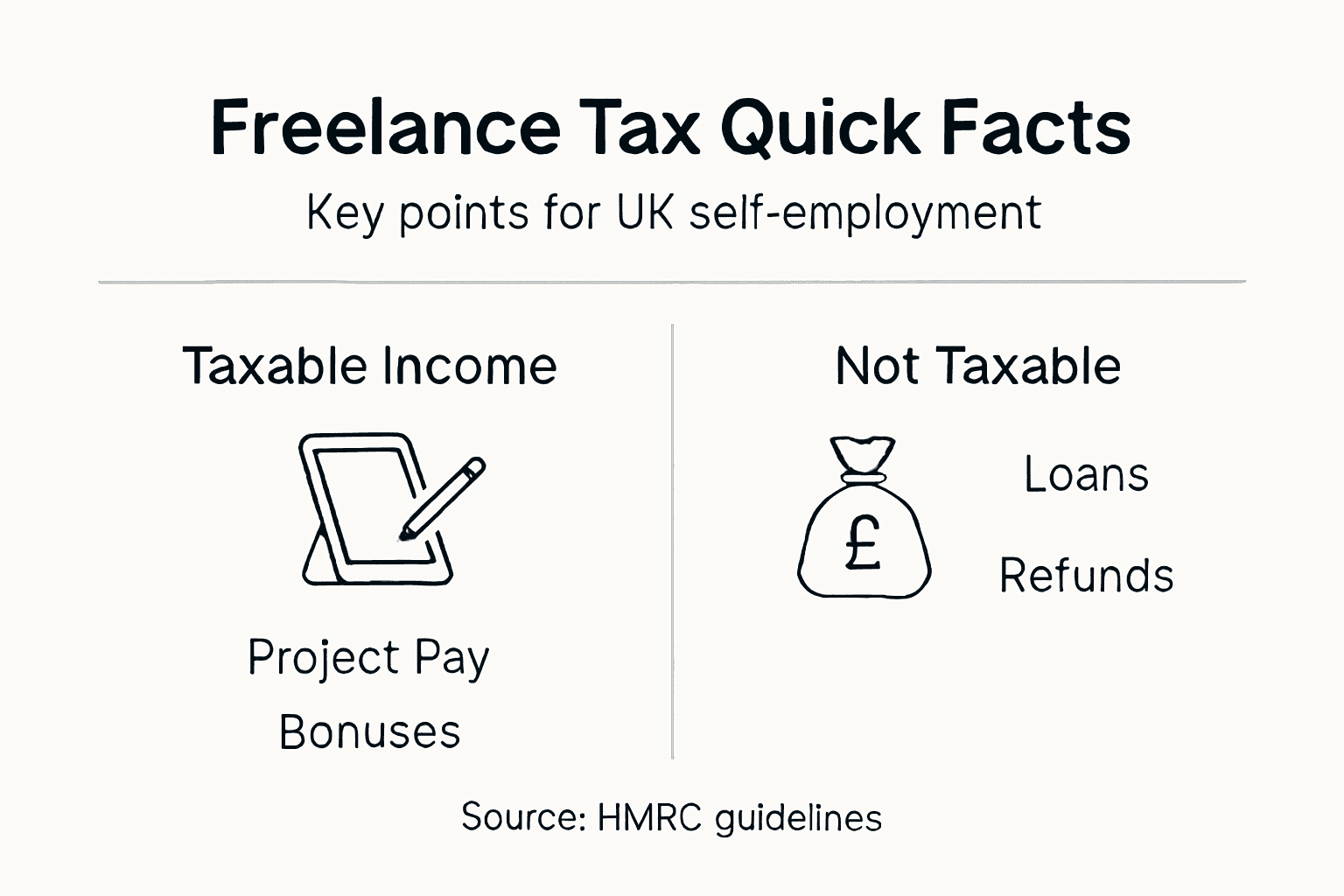
Income from self-employment includes earnings from freelancing, where you perform work or provide services to clients. This covers all payments you receive for work you’ve done—invoices paid, retainers, project fees, and one-off payments all count. If a client pays you for your time or expertise, it’s taxable income.
Here’s what definitely counts:
- Client payments for services you’ve provided
- Invoiced work, whether paid upfront or later
- Retainer fees and ongoing contracts
- One-off project payments
- Bonuses or additional payments from clients
- Payment in kind (if you receive goods instead of cash—you must declare the market value)
Income That Doesn’t Count
Some money you receive isn’t taxable. Personal loans from friends or family don’t count as income. Money you’ve borrowed and must repay isn’t earnings. Grants or awards that aren’t payment for work also sit outside the tax net.
If you receive a refund from a client for work that didn’t work out, that’s not income either—it reduces what you earned. Similarly, money you hold on behalf of clients (like deposits for future work) isn’t yours to keep, so it’s not taxable income.
To clarify which income types are taxable, here is a comparison of what counts towards freelance earnings and what does not:
| Income Source | Taxable as Freelance Income | Notes |
|---|---|---|
| Client project payments | Yes | All work completed for clients must be declared |
| Personal loans | No | Loans from individuals are not earnings |
| Refunds for cancelled jobs | No | Treated as adjustments, not income |
| Payment in kind | Yes | Declare market value of goods received |
| Retainer and bonuses | Yes | All extra payments from clients are taxable |
| Money held for clients | No | Deposits for future work are not freelance income |
| Grants for non-work | No | Only if not given in exchange for services |
Mixed Income Sources
Many freelancers earn from multiple sources. You might do freelance writing for one client, graphic design for another, and teach workshops occasionally. Each source is still freelance income and must be declared.
If you also have a part-time job as an employee, that income is separate and handled through PAYE. Your freelance income sits alongside it on your Self Assessment return. Each income source requires separate tracking.
Currency and Timing
If clients pay you in foreign currency, you must convert it to pounds sterling using the exchange rate on the day you received payment. That converted amount is your taxable income. Keep records of exchange rates used.
Income counts in the tax year you receive it, not when you invoice it. If a client pays you in April for work done in March, that’s April’s income. This matters for planning across tax years.
Declare all income you receive for work performed, regardless of invoice date or payment method. HMRC expects complete transparency.
Pro tip: Create a simple spreadsheet listing each client payment with the date received and amount in pounds—this makes Self Assessment filing quick and reduces the risk of accidentally omitting income.
How Income Tax for Freelancers Works
Income tax for freelancers works differently from PAYE because you manage the entire process yourself. There’s no employer deducting tax automatically, so you must calculate what you owe and pay it directly to HMRC. This responsibility can feel daunting, but the process is straightforward once you understand the steps.
The foundation is simple: your taxable profit equals your income minus allowable business expenses. Income tax and National Insurance contributions are calculated based on the profit from self-employment after deducting those expenses. Lower expenses mean higher profit and higher tax. This is why tracking every legitimate business cost matters.
Here’s the basic calculation:
- Total income from clients
- Minus allowable business expenses
- Equals taxable profit
- Tax is calculated on this profit at your applicable rate
Understanding Your Tax Rate
Your tax rate depends on how much profit you make. For the 2024/25 tax year, the basic rate is 20% on profit between £12,570 and £50,270. If your profit exceeds £50,270, the higher rate of 40% applies to amounts above that threshold.
You also pay National Insurance contributions on self-employment profit. This is separate from income tax but calculated alongside it. Class 2 contributions are a flat rate, whilst Class 4 contributions are percentage-based on profit.
Below is a summary of income tax and National Insurance contributions for UK freelancers in 2024/25:
| Profit Band | Income Tax Rate | National Insurance (Class 2 / Class 4) |
|---|---|---|
| Up to £12,570 | 0% (personal allowance) | Class 2 if profit exceeds threshold |
| £12,571–£50,270 | 20% (basic rate) | Class 2 plus 6% Class 4 contributions |
| Over £50,270 | 40% (higher rate) | Class 2 plus 2% Class 4 contributions |
| Over £125,140 | 45% (additional rate) | Class 2 plus 2% Class 4 contributions |
The Self-Assessment Process
You file a Self-Assessment tax return each year to tell HMRC about your income, expenses, and tax liability. This return covers the tax year from 6 April to 5 April the following year. Most freelancers file online, and the deadline is 31 January after the tax year ends.
The return asks for detailed information about your business. You’ll need records showing total income, itemised expenses, and any other financial details. HMRC uses this information to verify your tax calculation is correct.
Payment Deadlines
Payment is due by 31 January following the tax year. If you miss this deadline, HMRC charges penalties and interest. Payment can be made online, by bank transfer, or through other approved methods.
Some freelancers receive notices to pay tax in two instalments—usually by 31 July and 31 January. These are advance payments based on the previous year’s tax bill, designed to spread costs throughout the year.
Self-employed tax is your responsibility entirely. Late payments incur penalties, so marking the 31 January deadline in your calendar is non-negotiable.
Pro tip: Set aside roughly 25-30% of your net profit each month in a separate savings account—when the tax bill arrives on 31 January, you’ll have the money ready rather than scrambling to find it.
Filing Your Tax Return With HMRC
Filing your tax return with HMRC is straightforward once you’ve gathered your financial records. Most freelancers complete the process online through the HMRC portal, which is quicker and more reliable than paper forms. The key is submitting by the 31 January deadline to avoid penalties.
Before you start, gather everything you need. Collect invoices showing all income received, receipts for business expenses, records of National Insurance payments, and any other relevant financial documents. Having these organised makes the filing process faster and reduces errors.
Self-employed individuals file tax returns online or on paper, declaring income and expenses through the HMRC system. The online filing process guides you through each section step-by-step. You enter your income, list your expenses by category, and HMRC calculates your tax liability automatically.
Here’s what the return asks for:
- Total income from all sources
- Breakdown of business expenses by type
- Capital allowances (if applicable)
- Any other income or adjustments
- Previous year’s tax position
Registering for Self-Assessment
If you haven’t already, you must register for Self-Assessment before filing. Registration typically happens automatically when you become self-employed, but you can register manually through the HMRC website. The process takes minutes and you’ll receive a UTR (Unique Taxpayer Reference) number.
You need this UTR to file your tax return. It’s a 10-digit number unique to your tax account. Keep it safe—you’ll use it every year for filing and communicating with HMRC.
Step-by-Step Filing Process
Logging into your HMRC account is the first step. Use your login details or set up access if this is your first time. The system then guides you through sections for income, expenses, and additional information.
Answer each question honestly and completely. If something doesn’t apply to you, you can skip it. Review all entries before submitting—HMRC checks for obvious errors and will flag them before you submit.
Submitting the return is the final step. Once submitted, you receive a confirmation. HMRC processes the return and calculates any tax owing. If you’re owed a refund, this usually arrives within weeks.
File by 31 January to avoid automatic penalties. The online system lets you file anytime before midnight on that date.
Pro tip: File your return as soon as possible after the tax year ends (6 April) rather than waiting until January—this gives HMRC time to process it, and you’ll know your tax bill earlier to plan payments.
Common Pitfalls and Mistakes to Avoid
Many freelancers make preventable mistakes on their tax returns that cost them money or attract HMRC attention. Understanding these pitfalls upfront means you can avoid them entirely. A few simple habits protect your finances and keep your record clean with HMRC.
The most common error is underreporting income. Freelancers sometimes forget invoices paid months earlier or assume small payments don’t matter. Every pound earned must be declared—HMRC has records of payments from major platforms and can cross-check your reported figures.
Here are mistakes that trip up most new freelancers:
- Forgetting to track cash payments from clients
- Claiming personal expenses as business costs
- Missing invoices from the previous financial year
- Not keeping receipts to back up expense claims
- Mixing personal and business finances
- Filing after the 31 January deadline
- Overstating expenses without proper documentation
Expense Claiming Errors
Disallowable expenses are the second major pitfall. You can’t claim personal items, even if they’re work-related. Your home internet bill can’t be fully claimed just because you work from home—only the business portion is allowable.
Common disallowed expenses include car insurance, commuting costs, and personal clothing. The tax authorities scrutinise expenses carefully, particularly round numbers or unusually high amounts. Always keep receipts proving what you spent and why it’s legitimate business expenditure.
Record Keeping Issues
Poor record organisation creates stress at tax time. When January arrives and you’re scrambling to find receipts from April, mistakes happen. You might forget expenses entirely or misremember amounts, leading to inaccurate returns.
Digital systems work better than paper. Photograph receipts immediately, store them in cloud folders, and create a monthly summary. This takes minutes each week and prevents last-minute panic.
Late Filing Penalties
Missing the 31 January deadline triggers automatic penalties. First-time late filing costs £100. Repeat offences escalate to £10 daily charges after three months. Avoiding these penalties requires understanding what mistakes commonly occur when filing your Self Assessment return.
The deadline is non-negotiable. Mark it in your calendar well in advance and file by early January to avoid last-minute issues.
Small mistakes compound into bigger problems. HMRC uses data matching to spot inconsistencies, so accuracy and completeness matter from your first return.
Pro tip: Create a quarterly expense checklist (office supplies, subscriptions, insurance, professional fees) and review it each month—this ensures nothing slips through the cracks when filing time arrives.
Take Control of Your Freelance Taxes with Confidence
Managing freelance income tax in the UK can feel overwhelming, especially when you’re responsible for tracking every payment, claiming allowable expenses, and meeting tight HMRC deadlines. If you want to avoid costly mistakes like underreporting income or missing the 31 January deadline, you need a solution tailored to the unique challenges of self-employment. Our tools simplify tax filing by guiding you through income entry, expense claims, and tax calculations so you can focus on growing your business without the stress.
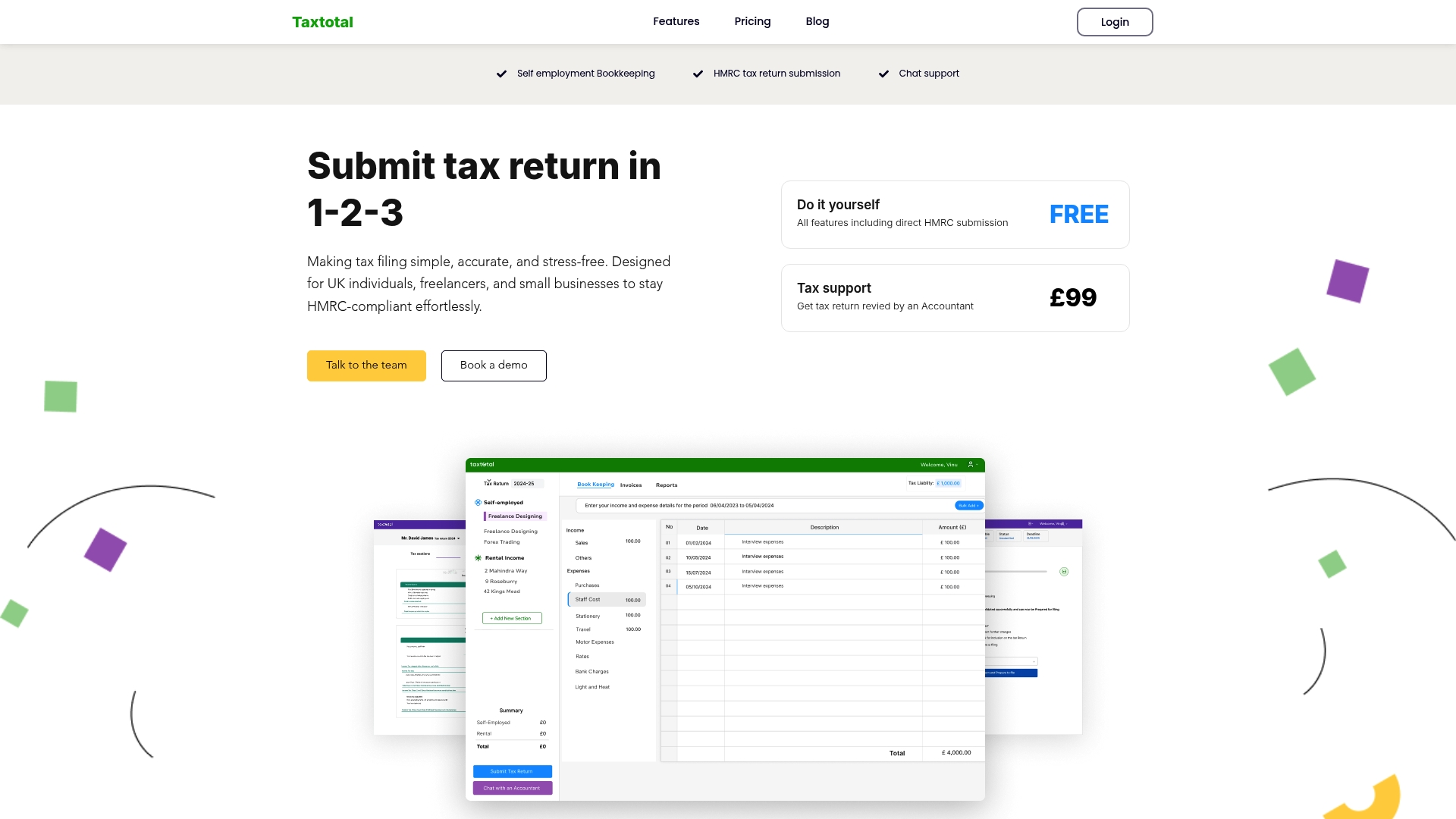
Start mastering your Self Assessment today by visiting Taxtotal.co.uk. Explore our Accounting Archives – Taxtotal to get deeper insights into managing your finances. If you need personalised assistance, our Tax Support Archives – Taxtotal provides expert advice to keep your tax affairs compliant and straightforward. Take the next step and enjoy peace of mind knowing your freelance tax obligations are handled accurately and on time.
Frequently Asked Questions
What is freelance income tax in the UK?
Freelance income tax is the tax self-employed individuals pay on earnings from their freelance work. Unlike employees, freelancers are responsible for calculating and paying this tax directly to HMRC.
How do I determine my taxable income as a freelancer?
Your taxable income is calculated by subtracting allowable business expenses from your total income. Keeping accurate records of all income and expenses is essential for correct reporting.
What types of income must I declare as a freelancer?
You must declare all earnings from client project payments, retainers, bonuses, and even payment in kind (goods received instead of cash). Personal loans, refunds, and deposits held for clients do not count as taxable income.
What are the deadlines for filing my Self Assessment tax return?
The deadline for filing your Self Assessment tax return is 31 January after the end of the tax year. Payments are also due by this date to avoid penalties. It’s advisable to start your filing as soon as possible after the tax year ends.