
Many UK self-employed taxpayers believe they must send every receipt and invoice to HMRC with their Self Assessment tax return. This is false. HMRC only requires you to keep these documents and produce them if requested. Understanding HMRC’s actual role in Self Assessment helps you file accurately, meet deadlines, and avoid penalties that start at £100 for late submission.
Table of Contents
- Understanding HMRC’s Role In Self Assessment
- HMRC Registration And Compliance Requirements
- Key Deadlines And Penalties Enforced By HMRC
- HMRC’s Role In Tax Calculation And Payment
- HMRC Digital Submission Platform And Error Checking
- Common Filing Errors And How To Minimize Them
- Common Misconceptions About HMRC Submission
- Correcting Errors And Maintaining Compliance With HMRC
- Simplify Your HMRC Self Assessment With Expert Support
- Frequently Asked Questions
Key Takeaways
| Point | Details |
|---|---|
| HMRC collects income tax via Self Assessment | Over 12 million UK taxpayers submit Self Assessment returns annually to report non-PAYE income. |
| Registration deadline is critical | Self-employed individuals must register by 5 October after the tax year ends to avoid penalties. |
| Filing deadlines differ by method | Paper returns due 31 October, online submissions due 31 January following the tax year. |
| Late filing triggers immediate penalties | £100 fine applies instantly for late submission, with escalating charges after 3, 6, and 12 months. |
| Online platform reduces errors | HMRC’s digital system provides real-time validation checks to minimize mistakes during submission. |
Understanding HMRC’s Role in Self Assessment
HMRC administers income tax collection for UK self-employed individuals through the Self Assessment system. This process requires you to report annual income that isn’t taxed through PAYE, including freelance earnings, rental income, and business profits. Over 12 million taxpayers submit Self Assessment returns each year, with the vast majority filing online.
The Self Assessment system shifts responsibility from HMRC to you. Unlike PAYE workers whose employers deduct tax automatically, self-employed individuals must calculate and report their own tax liability. HMRC then verifies your calculations, processes payments, and enforces compliance through registration requirements, strict deadlines, and financial penalties.
Understanding HMRC’s specific role helps you avoid common mistakes. HMRC does not prepare your tax return or remind you of deadlines. They provide the framework, tools, and penalties, but you must take action. This includes registering on time, keeping accurate records, calculating your tax correctly, and submitting returns before deadlines.
Key responsibilities HMRC manages include:
- Processing Self Assessment registrations and issuing Unique Taxpayer References
- Providing online and paper filing platforms with guidance materials
- Calculating final tax liability based on your submitted income and expense data
- Collecting tax payments and National Insurance contributions
- Enforcing penalties for late registration, filing, and payment
- Conducting compliance checks and requesting supporting documentation when necessary
Navigating the HMRC tax return process becomes significantly easier when you understand these core functions. HMRC’s role is to facilitate compliance, not to complete your filing for you.
HMRC Registration and Compliance Requirements
You must register for Self Assessment with HMRC by 5 October following the end of the tax year in which you started self-employment. The UK tax year runs from 6 April to 5 April. Missing this deadline results in immediate penalties, even if you owe no tax.
Registration requirements apply if you meet specific thresholds. You must register if you earn more than £1,000 from self-employment, receive untaxed income above certain limits, or meet other criteria such as being a company director or earning over £100,000 annually. HMRC does not automatically know when you become self-employed, making timely registration your responsibility.
Upon registration, HMRC issues a Unique Taxpayer Reference (UTR). This 10-digit number identifies you in their system and is essential for filing returns and making payments. You also receive a Government Gateway user ID and password for accessing HMRC’s online services. Keep these credentials secure, as you’ll need them every tax year.
Failure to register creates cascading problems. Without a UTR, you cannot submit your tax return, which triggers late filing penalties. These penalties accumulate daily after the deadline, quickly becoming expensive. Additionally, retrospective registration complicates your filing process and may trigger compliance investigations.
Key registration requirements include:
- Registering within the 5 October deadline after your first self-employment tax year ends
- Providing accurate personal details including National Insurance number
- Updating HMRC if your circumstances change, such as ceasing self-employment
- Maintaining your Government Gateway credentials for secure online access
Pro Tip: Register immediately when you start earning self-employed income, even if the 5 October deadline seems far away. Early registration gives you time to familiarize yourself with HMRC’s systems and prevents last-minute stress.
Key Deadlines and Penalties Enforced by HMRC
HMRC enforces strict deadlines for Self Assessment filing and payment. Paper returns must reach HMRC by 31 October following the tax year. Online submissions have an extended deadline of 31 January. Payment of all tax due, including balancing payments and payments on account, must be made by 31 January.
Late filing triggers immediate financial consequences. HMRC charges a £100 penalty the day after the deadline, regardless of whether you owe tax. If your return is 3 months late, daily penalties of £10 begin, capping at £900. After 6 months, HMRC adds 5% of the tax due or £300, whichever is greater. At 12 months late, another identical penalty applies.
Interest compounds the problem. HMRC charges interest on unpaid tax from the due date until you pay. This interest accrues daily and cannot be waived except in exceptional circumstances. Combined with penalties, delayed filing and payment become exponentially more expensive.
Comparing filing methods reveals significant advantages for online submission:
| Method | Deadline | Error Checking | Processing Speed | Confirmation |
|---|---|---|---|---|
| Paper Return | 31 October | None | Weeks | Postal receipt only |
| Online Return | 31 January | Real-time validation | Immediate | Instant digital confirmation |
The online deadline gives you three extra months to prepare your return. HMRC’s digital platform also provides immediate error detection, reducing the risk of mistakes that could trigger compliance checks or penalties. You receive instant confirmation of submission, eliminating uncertainty about whether HMRC received your return.
Pro Tip: Set personal deadlines at least two weeks before HMRC’s official dates. This buffer protects you from technical issues, forgotten documentation, or unexpected complications. Use HMRC’s online system to avoid filing mistakes and benefit from automated checks.
HMRC’s Role in Tax Calculation and Payment
HMRC calculates your final tax bill after you submit your Self Assessment return. The calculation uses your declared income, allowable business expenses, and personal allowances to determine your total tax liability. This includes Income Tax and Class 2 and Class 4 National Insurance contributions if you’re self-employed.
Accuracy in your submission directly affects HMRC’s calculation. Errors in reported income or expenses lead to incorrect tax bills. Underreporting income may trigger penalties and interest if HMRC discovers the mistake during compliance checks. Overreporting results in overpayment, which you must claim back through a formal process.
National Insurance contributions form part of your self-employed tax calculation. Class 2 NICs are flat-rate weekly contributions paid if your profits exceed £6,725 annually. Class 4 NICs are percentage-based contributions on profits between £12,570 and £50,270. HMRC includes both in your Self Assessment calculation alongside Income Tax.
Payment of your calculated tax and National Insurance must reach HMRC by 31 January following the tax year. If your tax bill exceeds £1,000, you may also need to make payments on account. These are advance payments toward next year’s tax, split between 31 January and 31 July. HMRC bases payments on account on your previous year’s liability.
Key calculation factors include:
- Total income from all self-employed sources and other taxable income
- Allowable business expenses that reduce your taxable profit
- Personal allowances such as the £12,570 tax-free personal allowance
- Capital allowances for business equipment and vehicle purchases
- Pension contributions that reduce your tax liability
Pro Tip: Keep detailed records throughout the year and verify all entries before submission. Double-checking your self-employed tax calculation reduces HMRC queries and ensures you pay the correct amount without overpaying or underpaying.
HMRC Digital Submission Platform and Error Checking
Approximately 90% of Self Assessment returns are now submitted online to HMRC. The digital platform offers significant advantages over paper filing, including extended deadlines, instant validation, and faster processing. Accessing the system requires your Government Gateway credentials, which HMRC provides when you register.
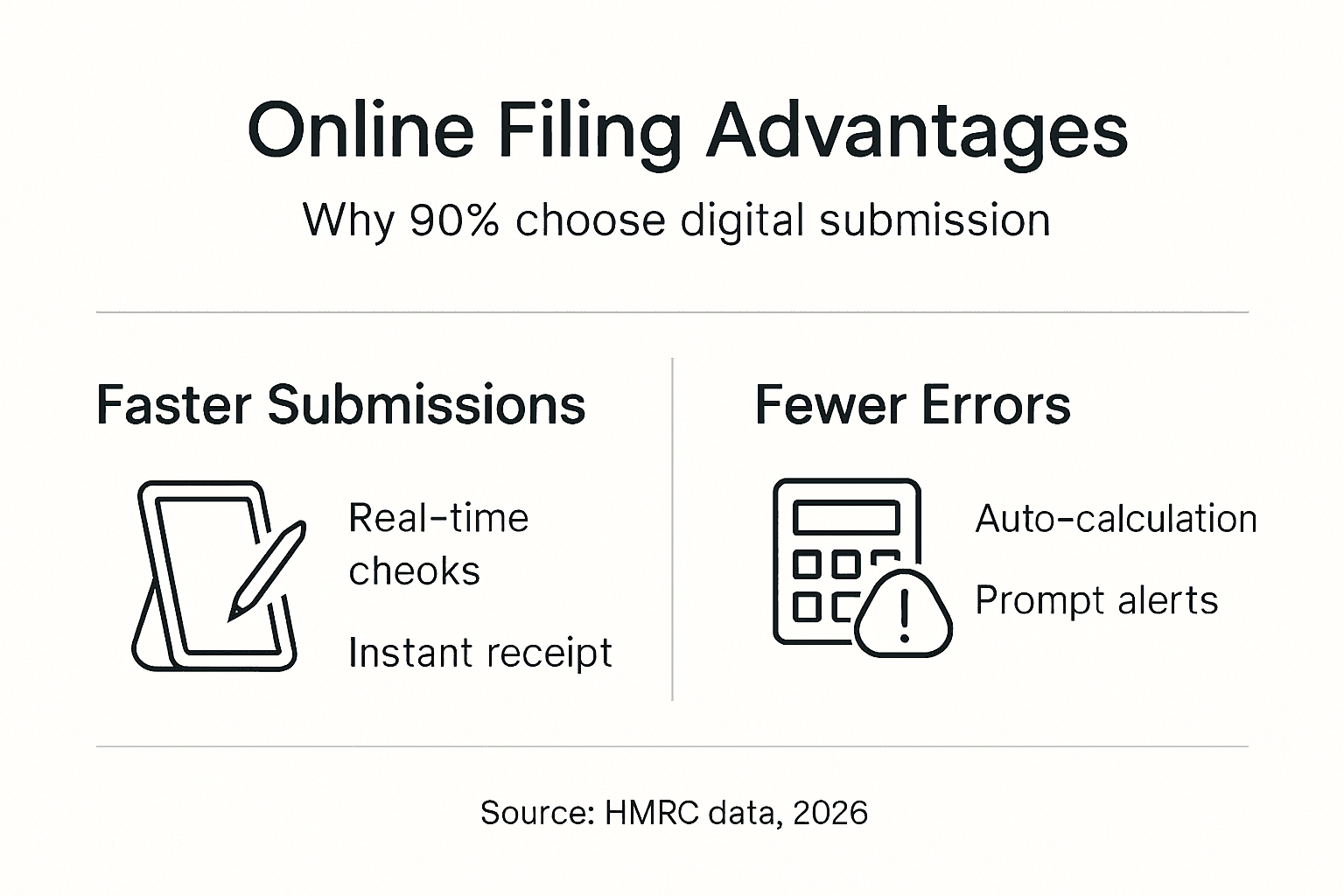
The online system provides real-time error checking as you enter data. If you input incompatible figures, miss mandatory fields, or enter values outside expected ranges, the system alerts you immediately. This validation prevents common mistakes that paper filers only discover when HMRC rejects their returns weeks later.
Submission confirmation is instant. Once you complete and submit your return online, HMRC generates a confirmation reference number immediately. This removes uncertainty about whether your return arrived and provides proof of timely submission if disputes arise. Paper submissions offer no such assurance until HMRC processes them.
The Government Gateway ensures secure access to your tax information. You log in using your user ID and password, with optional two-factor authentication for enhanced security. Through this portal, you can view previous returns, check payment history, update personal details, and manage Self Assessment tasks year-round.
Online platform benefits include:
- Extended filing deadline of 31 January compared to 31 October for paper
- Automatic arithmetic checks that prevent calculation errors
- Built-in validation rules that catch missing or inconsistent data
- Instant submission confirmation with reference number for your records
- Ability to save progress and return to complete your return later
- Access to previous years’ returns for reference and accuracy
Pro Tip: Submit your return online well before the 31 January deadline to fully utilize HMRC’s error detection features. Starting early gives you time to resolve any flagged issues without the stress of looming deadlines.
Common Filing Errors and How to Minimize Them
Frequent mistakes in Self Assessment returns trigger HMRC penalties, compliance checks, and payment disputes. Common errors include incorrect income reporting, missing allowable expenses, mathematical mistakes, and late submission. Paper submissions suffer higher error rates because they lack the immediate feedback that digital platforms provide.
Incorrect income reporting stems from poor record keeping. Forgetting to include all income sources, such as side jobs or occasional freelance work, creates discrepancies HMRC can detect through third-party reporting. Similarly, claiming non-allowable expenses or inflating deductible costs raises red flags during compliance checks.
Digital tools significantly reduce filing errors. HMRC’s online platform validates entries in real time, preventing submission of incomplete or inconsistent data. Third-party software with built-in HMRC compatibility offers additional guidance, automatically calculating tax and flagging potential issues before you submit.
Steps to minimize errors when filing your Self Assessment return:
- Organize all income documentation including invoices, bank statements, and payment records before starting your return
- Use accounting software or HMRC-compatible platforms that provide automatic calculations and error detection
- Review every section carefully before moving to the next, ensuring accuracy of figures and completeness of entries
- Double-check calculations manually even if using software, particularly for complex deductions or multiple income sources
- Submit early to allow time for corrections if HMRC identifies issues or you discover mistakes
- Keep copies of your completed return and all supporting documentation for at least six years
Paper filing increases error risk because you cannot verify accuracy until HMRC processes your return. By then, you may face penalties or need to submit amendments. Online submission with immediate validation eliminates this uncertainty.
Pro Tip: Maintain regular bookkeeping throughout the tax year rather than scrambling at deadline time. Monthly reconciliation of income and expenses ensures accuracy, reduces stress, and makes year-end filing straightforward and error-free.
Common Misconceptions About HMRC Submission
Several myths about Self Assessment submission cause unnecessary confusion and stress. The most persistent misconception is that you must send receipts and invoices with your tax return. HMRC actually requires you to keep these records for at least six years and produce them only if requested during compliance checks. Submitting unnecessary documentation can delay processing.
Another common misunderstanding involves filing deadlines. Many taxpayers assume a single deadline applies regardless of submission method. In reality, paper returns are due 31 October while online submissions have until 31 January. Confusing these dates leads to unnecessary late filing penalties for those choosing paper when they could have filed online.
Registration requirements also generate confusion. Some believe that earning below the personal allowance exempts them from Self Assessment registration. However, if you meet specific criteria such as earning over £1,000 from self-employment, you must register regardless of your total tax liability. HMRC’s registration thresholds focus on income sources, not final tax owed.
Key misconceptions to avoid:
- You must submit receipts with your return (false: keep them for six years, submit only if HMRC requests)
- Paper and online filing have the same deadline (false: paper due 31 October, online due 31 January)
- Low earners don’t need to register (false: registration depends on income type and amount, not final tax)
- HMRC will remind you of deadlines (false: you are responsible for tracking and meeting all dates)
- Paying tax late avoids filing penalties (false: filing and payment penalties are separate and both apply)
Clearing these misconceptions prevents errors and reduces anxiety. Understanding HMRC’s actual requirements helps you focus on genuine compliance obligations rather than imagined ones. Accurate knowledge of submission processes ensures smooth, penalty-free tax filing.
Correcting Errors and Maintaining Compliance with HMRC
Mistakes happen, even with careful preparation. HMRC allows amendments to submitted Self Assessment returns within 12 months of the 31 January filing deadline. This grace period lets you correct errors without facing penalties, provided you act promptly after discovering mistakes.
You can amend your return online through your Government Gateway account or by contacting HMRC directly by phone. Online amendments are processed faster and provide immediate confirmation. For significant changes, HMRC may request supporting documentation to verify the corrections before adjusting your tax account.
Timely amendments protect you from additional penalties and interest charges. If you discover you underreported income or overclaimed expenses, correcting the error quickly demonstrates good faith and reduces HMRC’s suspicion of deliberate evasion. Voluntary disclosure before HMRC identifies the problem typically results in more lenient treatment.
Keep comprehensive records of all amendments and communications with HMRC. Document what you changed, why, and when you notified HMRC. This paper trail proves useful if disputes arise or HMRC questions the correction during later compliance reviews.
Maintaining ongoing compliance requires:
- Reviewing completed returns carefully before the amendment deadline passes
- Setting calendar reminders for the 12-month amendment window
- Documenting all changes made to submitted returns with supporting evidence
- Responding promptly to HMRC queries or requests for additional information
- Keeping all tax records organized and accessible for at least six years
Proactive compliance management reduces audit risks. HMRC targets taxpayers with repeated errors or patterns suggesting carelessness or evasion. Demonstrating consistent accuracy and prompt correction of genuine mistakes keeps you in good standing. For complex situations, consider correcting tax return errors with professional guidance to ensure proper handling.
Simplify Your HMRC Self Assessment with Expert Support
Meeting HMRC requirements doesn’t have to be overwhelming. Understanding registration deadlines, filing processes, and calculation methods provides a solid foundation. However, professional support can eliminate stress and ensure accuracy.
Taxtotal offers comprehensive resources to help UK self-employed individuals navigate Self Assessment successfully. Our tips for preparing Self Assessment tax returns guide you through each stage, from gathering documentation to final submission. You’ll learn how to maximize allowable deductions while maintaining compliance.
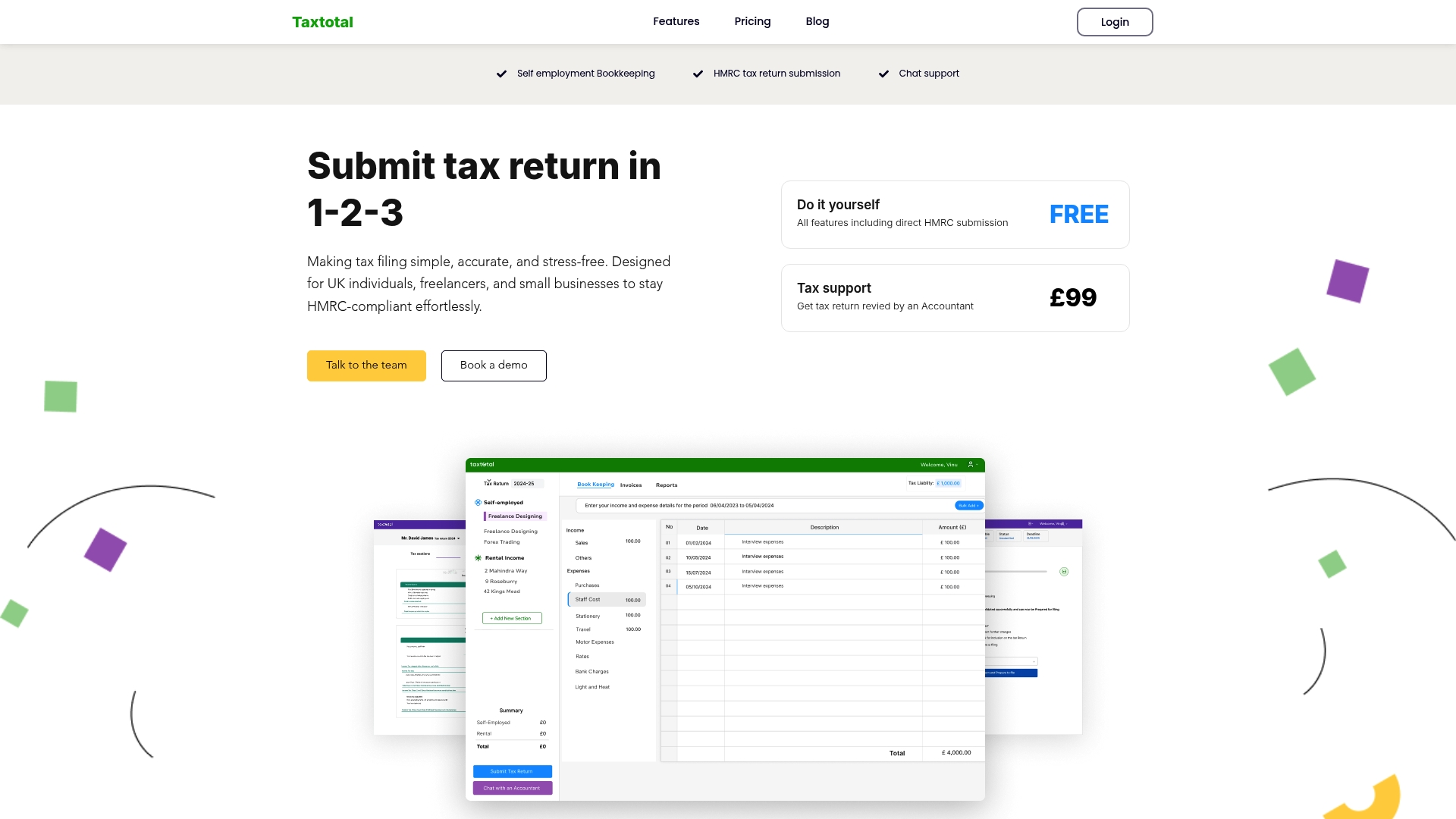
Common filing errors cost taxpayers thousands in penalties annually. Our detailed guide on how to avoid common filing mistakes identifies the most frequent problems and provides actionable solutions. Real-time error checking through our platform catches issues before they become HMRC problems.
New to Self Assessment? Our comprehensive explanation of what Self Assessment tax means clarifies your obligations and demystifies the process. You’ll gain confidence in managing your tax affairs independently or with expert assistance.
Frequently Asked Questions
Who must register for Self Assessment with HMRC?
You must register if you earn over £1,000 from self-employment, receive untaxed income above certain limits, or meet other criteria such as being a company director or earning over £100,000 annually. Registration deadline is 5 October following the tax year you started.
What are the deadlines for filing and paying Self Assessment tax?
Paper returns are due 31 October after the tax year ends. Online submissions have until 31 January. Payment of all tax owed must reach HMRC by 31 January following the tax year.
Do I need to send receipts with my tax return?
No. HMRC requires you to keep receipts and invoices for at least six years but does not want them submitted with your return. Produce them only if HMRC specifically requests them during compliance checks.
How can I amend my tax return if I make a mistake?
You can amend your submitted return online through your Government Gateway account or by contacting HMRC directly. You have 12 months from the 31 January filing deadline to make corrections without penalty.
What penalties does HMRC impose for late filing?
HMRC charges £100 immediately after the deadline. After 3 months, daily penalties of £10 apply, capping at £900. At 6 and 12 months late, additional penalties of 5% of tax due or £300 (whichever is greater) are added.