Completing a HMRC tax return often feels overwhelming for self-employed freelancers and sole traders across the United Kingdom. The rules, deadlines, and paperwork can be confusing, especially when so many myths circulate about who must file and what counts as income. Understanding the real requirements behind Self Assessment is key to avoiding penalties and keeping your business on the right side of the law. This guide breaks down the process, tackles common misconceptions, and highlights the steps you need to take for simple, stress-free compliance.
Table of Contents
- HMRC Tax Return: Core Definition And Myths
- Who Must File And Key Eligibility Rules
- Self Assessment Types And Main Variations
- How The Filing Process Works Step By Step
- Common Mistakes, Penalties, And Compliance Risks
Key Takeaways
| Point | Details |
|---|---|
| Self Assessment Requirement | Individuals with untaxed income, including the self-employed, landlords, and freelancers, must file a tax return if requested by HMRC. |
| Penalties for Late Submission | Missing filing deadlines incurs immediate fines, which increase over time, so timely submissions are crucial. |
| Accurate Record-Keeping | Maintaining organised records of income and expenses ensures compliance and reduces scrutiny from HMRC. |
| Use Appropriate Forms | Choosing the correct supplementary pages based on your income type is essential to avoid compliance issues. |
HMRC tax return: core definition and myths
An HMRC tax return (formally called Self Assessment) is how you tell the taxman about your income each year. Unlike employees who have tax deducted automatically from their wages, self-employed workers must report their earnings directly.
HMRC requires a tax return when you have income not taxed at source. This includes freelance fees, business profits, rental income, or investment returns. If HMRC sends you a notice to file, it becomes mandatory.
What a tax return actually contains
The main document you’ll complete is the SA100 form, the standard Self Assessment return. You’ll need specific information to hand:
- Your Unique Taxpayer Reference (UTR) number
- Your National Insurance Number (NINO)
- Full details of all income sources
- Eligible expenses and deductions
- Tax paid during the year
The form looks daunting on paper, but it’s simply asking you to account for money in and money out.
Common myths about tax returns
Self-employed workers often believe things about tax returns that simply aren’t true. Here’s what people get wrong:
- “Only self-employed people file returns” – Wrong. Anyone with untaxed income must file, including landlords, freelancers, and contractors.
- “I can file late without consequences” – Late submissions trigger penalties. HMRC doesn’t forgive missed deadlines.
- “I don’t need to file if I’ve earned very little” – If HMRC asks for a return, you must submit one, regardless of profit.
- “The tax man won’t check my figures” – HMRC uses sophisticated data matching to identify discrepancies.
Filing on time and accurately protects you from penalties and keeps HMRC off your back. The effort you invest now saves stress later.
Deadlines and penalties matter
There are two critical deadlines: 31 January for online returns and 31 October for paper forms. Missing these dates costs you money through penalties for late submissions.
The penalty structure starts at £100 and increases based on how late you submit. A three-month delay costs more than a one-week delay.
Accuracy matters just as much as timing. Incorrectly completed returns invite questions, audits, and additional fines.
Pro tip: Start gathering your income and expense records by October, giving yourself three months to compile figures accurately before the January deadline.
Who must file and key eligibility rules
Not every self-employed person needs to file a tax return. HMRC has specific thresholds and rules that determine whether you’re legally required to submit one. Understanding these rules saves you time if filing isn’t mandatory for you.
You must file a Self Assessment tax return if you’re self-employed as a sole trader earning over £1,000 (before expenses) in the tax year. This applies even if you’re only freelancing part-time alongside employment.

Other situations that trigger a filing requirement
Self-employment income isn’t the only trigger. You’ll also need to file if you have:
- Property rental income from UK or overseas properties
- Untaxed savings or investment income above certain thresholds
- Foreign income from any source
- Capital gains above the annual exemption threshold
- Profit from selling a business or assets
- The High Income Child Benefit Charge applied to your household
- Partnership income if you’re a business partner
If any of these apply, filing becomes mandatory regardless of how much you’ve earned.
How to know for certain
Unsure whether you need to file? HMRC provides an online eligibility checker that asks questions about your income sources and tells you instantly whether you must file.
This tool covers every scenario including unusual income types. It’s far quicker than guessing and removes doubt.
The critical notification deadline
If you’ve just become self-employed or your circumstances have changed, you must notify HMRC by 5 October if you need to file for that tax year. Missing this deadline results in fines, even if you later submit a perfect return.
This notification tells HMRC you exist as a taxpayer. Without it, you could face penalties up to £3,000.
If your circumstances change mid-year—whether you start freelancing or inherit property—register immediately. The 5 October deadline is absolute and HMRC won’t extend it.
Registration is straightforward and takes minutes online. Once registered, you’ll receive a Unique Taxpayer Reference (UTR) number used for all future filings.
Pro tip: Register with HMRC as soon as your circumstances change, don’t wait until October. Early registration gives you time to gather records and understand your filing obligations without rush.
Self Assessment types and main variations
One tax return doesn’t fit all situations. HMRC recognises that freelancers, landlords, and business partners have completely different financial structures. That’s why Self Assessment comes in several variations, each designed to capture your specific circumstances accurately.
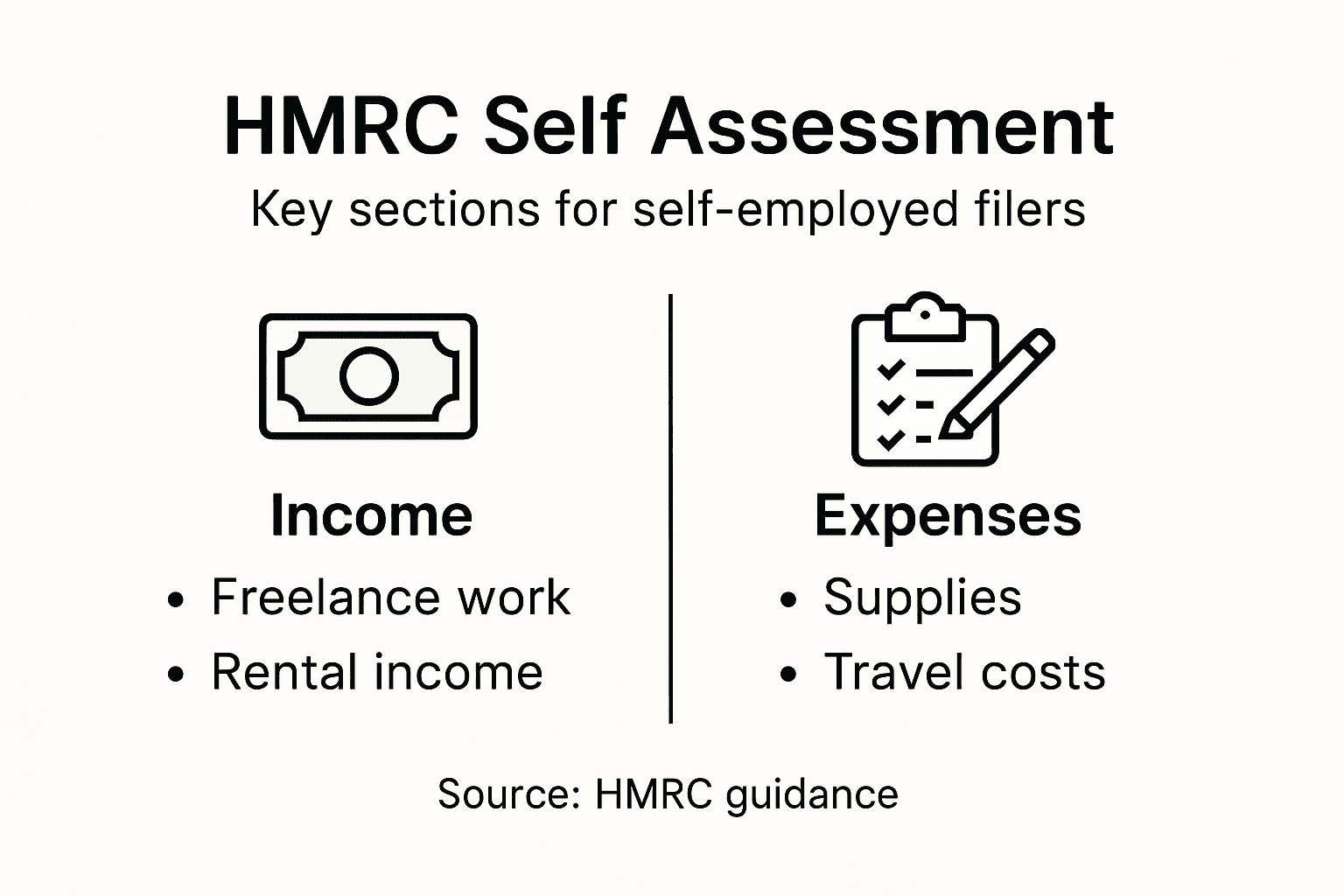
The core document is the SA100 form, which everyone completes. However, you’ll also need supplementary pages depending on your income sources and business type. Choosing the right ones ensures you’re reporting everything correctly without including irrelevant sections.
Main supplementary pages for self-employed workers
If you’re self-employed, you’ll use self-employment pages. HMRC offers two versions:
- SA103S (Short) – For straightforward freelancers with simple records and turnover under £85,000
- SA103F (Full) – For larger businesses or complex situations requiring detailed breakdowns
Both ask about income and expenses, but the full version digs deeper into areas like capital allowances and adjustments. Choose based on your business complexity, not your preference.
Other common supplementary pages
If you have multiple income types, you’ll complete additional forms:
- SA104S/F – Partnership income (short or full, depending on partnership size)
- SA105 – Property rental income from UK properties
- SA106 – Foreign income and overseas property
- SA108 – Capital gains from asset sales
- SA109 – Non-resident or dual resident circumstances
Each form targets a specific income type, ensuring nothing gets missed or duplicated.
How to choose which forms you need
Determining the correct supplementary pages depends entirely on your individual circumstances. If you’re unsure whether you need property or foreign income forms, it’s better to include them unnecessarily than to omit them by accident.
Including blank forms doesn’t cause problems. Excluding required ones attracts HMRC’s attention and may trigger penalties for incomplete reporting.
Self Assessment forms aren’t interchangeable. Using the wrong supplementary page won’t produce the right tax calculation and could invite questions from HMRC about your accuracy and compliance.
Complexity matters when choosing versions
The short versus full self-employment decision is straightforward. Small freelancers with basic expenses use SA103S. Established businesses with multiple income adjustments use SA103F.
If you’re uncertain, go with the full version. You can always leave sections blank, but using too simple a form creates compliance issues.
Pro tip: Download all potentially relevant forms before you start, so you can see which ones apply to your situation rather than discovering halfway through that you’ve missed one.
How the filing process works step by step
Filing a Self Assessment tax return follows a logical sequence from preparation through payment. Understanding each stage removes confusion and helps you meet deadlines without stress.
The process spans nearly a full year, starting from April when the tax year begins and concluding by 31 January when payment is due. Breaking it into phases makes the workload manageable.
Phase 1: Gathering and organising your records
Before you open a tax form, collect everything you’ll need. This takes time but prevents scrambling later.
- Income records – invoices, payment receipts, bank statements
- Expense receipts – materials, equipment, software, travel costs
- Professional fees – accountancy, insurance, memberships
- Tax documents – P60s, interest statements, dividend notices
- Previous year’s return – helpful for reference
Organising records by category (supplies, travel, equipment) makes data entry faster and reduces errors. Digital copies save storage space and survive office chaos.
Phase 2: Choosing your filing method
You have two options: online or paper. Online filing offers significant advantages including extended deadlines and the ability to save progress. Paper returns must be submitted by 31 October, whilst online returns have until 31 January.
Almost all self-employed workers now file online. The online portal guides you through each section, catches basic errors, and automatically calculates your tax bill.
Here’s a comparison of online versus paper Self Assessment tax returns for a clearer understanding of their practical differences:
| Aspect | Online Submission | Paper Submission |
|---|---|---|
| Final Deadline | 31 January | 31 October |
| Error Detection | Automated prompts for mistakes | No automated checks |
| Amending Returns | Easily amended after submission | Complex, manual amendments |
| Confirmation | Immediate digital receipt | Delayed, posted confirmation |
| Processing Speed | Faster assessment and feedback | Slower due to manual handling |
Phase 3: Completing your tax return
Once registered, you’ll complete the SA100 form plus relevant supplementary pages. The actual filing typically takes 2–4 hours depending on complexity.
You’ll declare your income, enter allowable expenses, claim tax reliefs, and provide personal details. HMRC’s online system saves your progress, so you don’t need to finish in one sitting.
Filing online beats paper returns every time. You get three extra months to submit, immediate confirmation of submission, and fewer opportunities for arithmetic errors.
Phase 4: Submission and tax calculation
HMRC calculates your tax automatically once you submit. You’ll see what you owe or what’s owed to you instantly.
Keep your submission receipt as proof. HMRC won’t chase you if your documents go missing.
Phase 5: Payment
Payment is due by 31 January following the tax year. Miss this deadline and penalties begin accruing immediately at 5% of the tax owed.
You can pay by bank transfer, debit card, or cheque. Set a calendar reminder for mid-January so it doesn’t slip your mind.
Pro tip: File online by mid-December to give yourself breathing room before the January deadline, rather than waiting until the last week when systems are slow and problems emerge too late to fix.
Common mistakes, penalties, and compliance risks
Most penalties self-employed workers face aren’t accidents. They stem from preventable errors—missed deadlines, incomplete records, or simply not understanding what HMRC requires. Understanding these risks protects your finances and reputation.
The penalty system starts gently but escalates quickly. A minor slip becomes expensive fast, and deliberate errors invite serious consequences. Knowing what to avoid saves you thousands of pounds.
Deadline mistakes cost real money
Missing the filing deadline triggers an immediate £100 fine, regardless of how late you are. This isn’t a warning—it’s an actual penalty.
Wait three months past the deadline and the fine doubles. Six months late brings another penalty. If your return stays outstanding for a year, HMRC adds 5% of the tax owed on top of everything else.
Late payment penalties work separately. Pay your tax bill after 31 January and interest accrues daily. The longer you delay, the more interest compounds.
Use this table to summarise how late filings affect penalty costs and compliance risks:
| Time After Deadline | Penalty Amount | Additional Risks |
|---|---|---|
| Day one | £100 instant fine | None if paid immediately |
| Three months | Further £100 added | Greater HMRC scrutiny |
| Six months | 5% of tax still owed | May trigger compliance investigation |
| Twelve months | Additional 5% of unpaid tax | Risk of increased penalties and interest |
Common filing errors that invite scrutiny
These mistakes trigger HMRC investigations:
- Underreporting income – Claiming you earned less than you actually did
- Inflated expenses – Deducting costs that aren’t genuinely business-related
- Missing records – Unable to prove your claimed expenses
- Wrong supplementary pages – Omitting income types from your return
- Arithmetic errors – Basic calculation mistakes that look suspicious
- Inconsistent information – Different figures on different forms
Many errors are honest mistakes, but HMRC investigates everything that looks unusual. An investigation costs time, stress, and potentially more fines.
Not registering when you should
Some freelancers ignore registration requirements, thinking HMRC won’t notice. This is dangerous. Failing to register for Self Assessment when required results in fines and demands for back taxes with interest added.
Registration is simple and free. Avoiding it creates liability that multiplies over time.
Penalties escalate based on how long you ignore your obligations. A six-month delay costs triple what a two-week delay costs. Speed matters far more than perfection.
Record-keeping failures
Without receipts and records, you can’t prove your expenses. HMRC won’t accept “I think I spent that much.” If you can’t produce evidence, the expense gets disallowed and your taxable income increases.
Keep receipts for seven years. Digital scans survive office floods. Physical copies get lost.
How to avoid serious trouble
Protect yourself with simple practices:
- File by mid-January, never the last week
- Keep all receipts and invoices for seven years
- Use the correct supplementary pages for your income types
- Double-check figures before submitting
- Declare all income, no exceptions
- Keep business and personal finances separate
Pro tip: If you make a mistake after filing, correct it immediately by contacting HMRC rather than hoping they don’t notice—voluntary disclosure often results in lower penalties than discovered errors.
Simplify Your HMRC Tax Return with Taxtotal.co.uk
Navigating the complexities of the HMRC tax return can be overwhelming, especially when dealing with deadlines, supplementary pages, and the risk of penalties. If you are a self-employed individual in the UK, understanding the exact requirements and ensuring accurate, timely submission is crucial to avoid costly fines and stress. Taxtotal.co.uk understands these challenges and provides you with a clear, user-friendly platform designed specifically to help freelancers, sole traders, and landlords manage their Self Assessment tax returns confidently.
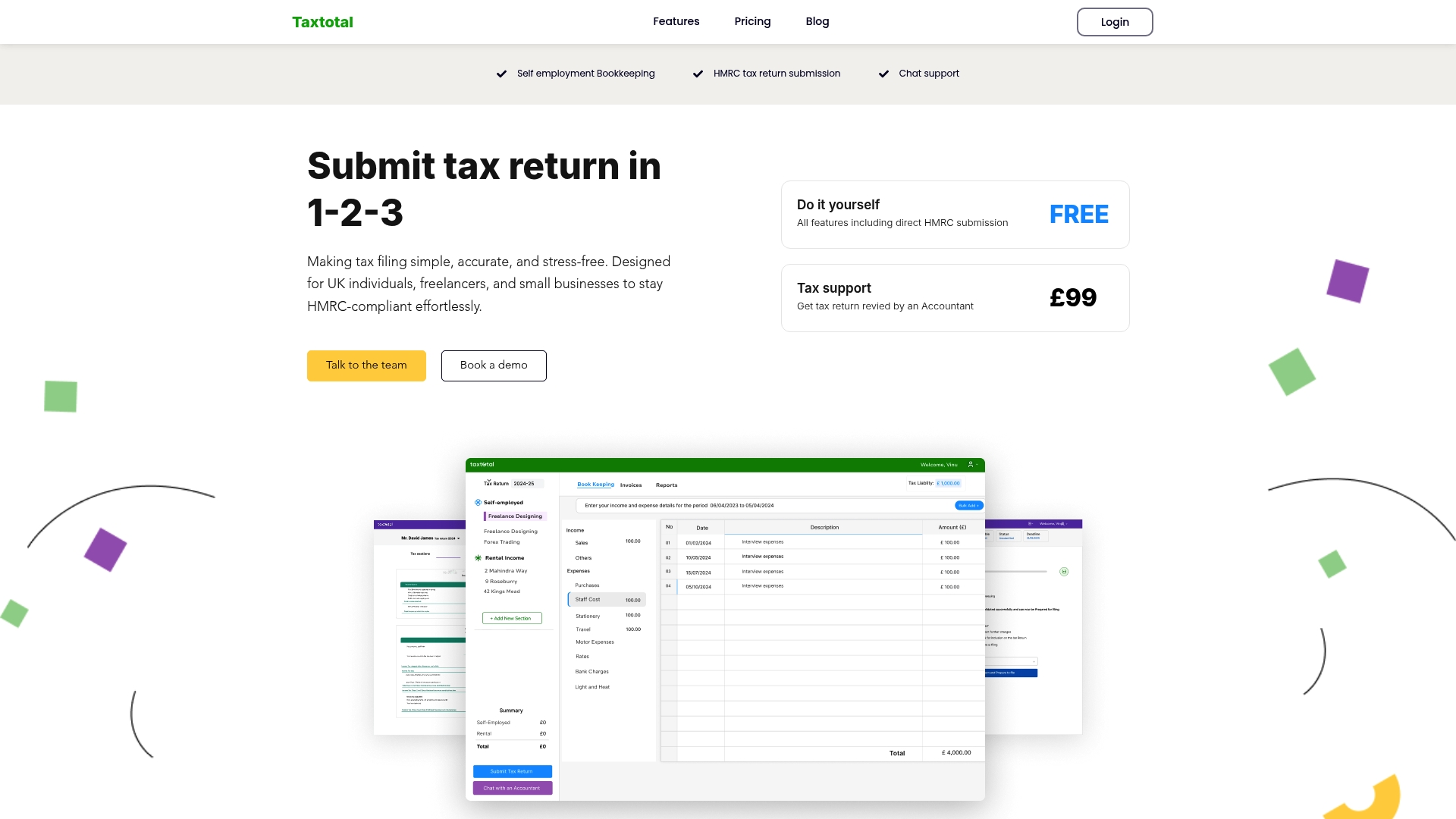
Take control of your tax obligations today by using Taxtotal.co.uk to prepare, review, and submit your Self Assessment return directly to HMRC. Benefit from real-time tax calculations, automatic error checking, and expert support that puts compliance and simplicity first. Don’t wait until the last minute and risk penalties. Get started now and protect your earnings effortlessly with our easy-to-use tax return service.
Frequently Asked Questions
What is an HMRC tax return?
An HMRC tax return, formally known as Self Assessment, is a document that self-employed workers and others with untaxed income must complete to report their earnings to HMRC each year.
Who needs to file a Self Assessment tax return?
You must file a Self Assessment tax return if you are self-employed earning over £1,000 before expenses, have property rental income, earn untaxed savings or investment income, or have foreign income, among other criteria.
What are the deadlines for submitting an HMRC tax return?
The key deadlines are 31 January for online submissions and 31 October for paper forms. Filing late can lead to penalties, so it’s crucial to adhere to these dates.
What are the consequences of filing a tax return late?
Filing a tax return late incurs an immediate £100 fine. If it’s more than three months late, additional penalties apply, and continued delays can result in increased fines and potential investigations by HMRC.