
Filing your Self Assessment tax return to HMRC shouldn’t feel like decoding secret government language, yet many UK freelancers struggle with the basics. Despite 90% of submissions now happening online, confusion about what HMRC submission actually involves and how to do it correctly persists. This guide explains exactly what HMRC submission means, walks you through the filing process step by step, and helps you avoid the costly mistakes that catch thousands of self-employed workers every year.
Table of Contents
- Understanding Hmrc Submission: What It Means
- Step-by-Step Process For Self Assessment Hmrc Submission
- Methods Of Hmrc Submission: Online Vs Paper
- Key Deadlines And Penalties For Hmrc Submission
- Common Misconceptions About Hmrc Submission
- Leveraging Digital Tools To Simplify Hmrc Submission
- Summary: Confident And Compliant Hmrc Submission For Freelancers
- Get Expert Help With Your Hmrc Submission Today
Key Takeaways
| Point | Details |
|---|---|
| Legal Requirement | Self-employed individuals must submit annual Self Assessment returns to HMRC declaring all income and expenses |
| Filing Methods | Online submission deadline is 31 January; paper returns must arrive by 31 October |
| Penalties | Late filing triggers an immediate £100 penalty, with additional charges accruing over time |
| Common Mistake | Submitting bookkeeping documents or invoices does not fulfill your legal filing obligation |
| Digital Advantages | Online platforms provide error checking, faster processing, and instant confirmation of submission |
Understanding HMRC Submission: What It Means
An HMRC submission for Self Assessment is the process of providing income, expenses, and other relevant financial information to HM Revenue & Customs to calculate your tax liability as a self-employed individual. Think of it as your annual financial report card to the government, except you’re grading yourself.
Every tax year runs from 6 April to 5 April the following year. When you complete the HMRC submission process for freelancers, you’re declaring everything you earned and spent during those twelve months. This isn’t optional. If you’re self-employed and earned more than £1,000 in a tax year, you must file.
Your submission needs to include specific components:
- Total income from self-employment and any other sources
- Allowable business expenses you can claim to reduce taxable profit
- National Insurance contributions already paid
- Any tax reliefs or allowances you’re eligible for
The information you provide determines how much tax and National Insurance you owe. Get the numbers wrong, and you’ll either overpay or face penalties for underpayment. The HMRC Self Assessment overview emphasizes accuracy because your submission forms the legal basis for your tax calculation.
“Understanding what constitutes a proper HMRC submission saves freelancers from the most common filing errors that trigger penalties and investigations.”
Many freelancers assume keeping good records equals filing their return. It doesn’t. You must actively submit your completed return through HMRC’s official channels. Your spreadsheet sitting on your laptop means nothing to the tax office until you formally lodge it using their system. Following the Complete HMRC tax submission checklist ensures you include every required element.
Step-by-Step Process for Self Assessment HMRC Submission
Filing your Self Assessment follows a logical sequence that becomes routine once you understand it. Registering for Self Assessment, gathering income and expense data, choosing filing method, and submitting by deadline are key steps to compliance. Breaking the process into manageable stages removes the intimidation factor.
-
Register for Self Assessment if you haven’t already done so. You need to register for Self Assessment with HMRC by 5 October following the end of the tax year you’re filing for. HMRC will send you a Unique Taxpayer Reference (UTR) number, which you’ll need for all future submissions.
-
Collect and organize all financial records for the complete tax year. This includes invoices, bank statements, receipts for business expenses, and records of any other income sources. When you prepare tax documents for Self Assessment, sort everything by category to make data entry smoother.
-
Choose your submission method based on which deadline works better for you and your comfort with technology. Online filing gives you until 31 January, while paper returns must reach HMRC by 31 October.
-
Complete your tax return accurately using your chosen method. Online systems calculate your tax liability automatically as you enter figures. Paper forms require manual calculation or professional help.
-
Submit your return and keep the confirmation reference HMRC provides. This proves you filed on time if any disputes arise later.
Pro Tip: Start gathering your records in February or March, not January when the deadline looms. Spreading the workload across several months reduces stress and gives you time to track down missing documents without panic.
The submission itself takes less time than gathering the information. Most freelancers spend hours organizing receipts and bank statements but only 30 to 60 minutes actually entering data into the return. Planning ahead transforms HMRC submission from a January nightmare into a manageable administrative task.
Methods of HMRC Submission: Online vs Paper
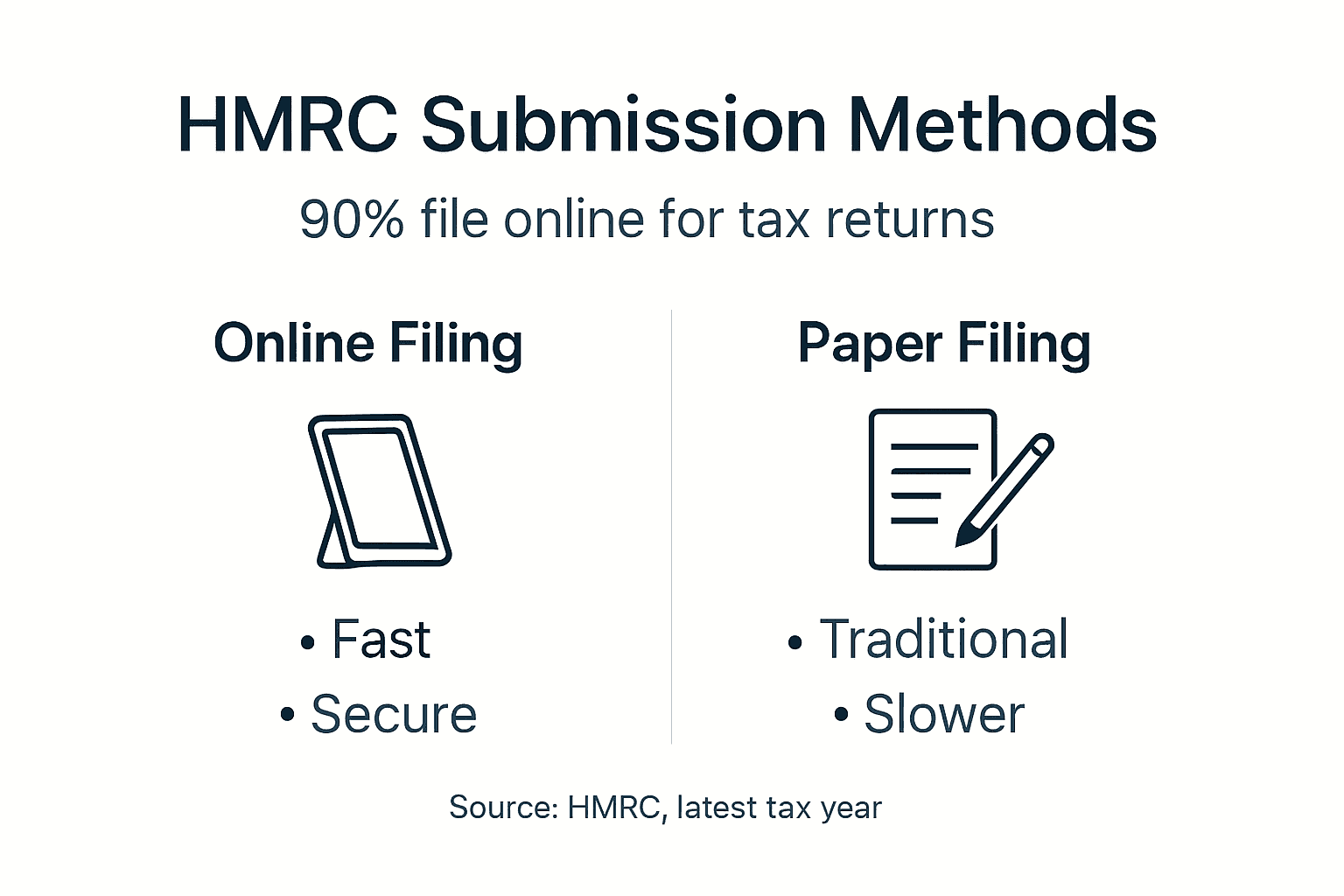
You have two official routes for submitting your Self Assessment, each with distinct advantages and limitations. Understanding the HMRC submission online and paper options helps you choose the method that fits your situation and working style.
| Feature | Online Submission | Paper Submission |
|---|---|---|
| Filing Deadline | 31 January | 31 October |
| Processing Speed | Immediate confirmation | 2-3 weeks minimum |
| Error Checking | Automatic validation | Manual review only |
| Tax Calculation | Instant automatic | Self-calculated |
| Security | Encrypted digital | Physical mail risk |
Online submission dominates because roughly 90% of Self Assessment filers now use digital methods. The benefits explain this overwhelming preference:
- Immediate confirmation that HMRC received your return
- Built-in error checking catches mathematical mistakes and missing information before submission
- Automatic tax calculation eliminates manual arithmetic errors
- Extended deadline gives you three extra months compared to paper
- Direct submission to HMRC databases speeds processing
Paper filing still exists for those without reliable internet access or who strongly prefer physical forms. However, the risks include slower processing, higher chance of postal delays or loss, manual calculation errors, and the earlier October deadline that catches many filers off guard.
Pro Tip: Even if you prefer working with paper records, consider entering your figures into the online system for submission. You get the security of digital filing while still organizing information your preferred way.
Security concerns sometimes worry first-time online filers, but HMRC’s digital system uses government-grade encryption. Your financial data travels more safely through their secure portal than paper forms do through the postal system. The convenience and accuracy of online submission make it the clear choice for most self-employed workers.

Key Deadlines and Penalties for HMRC Submission
Missing deadlines costs real money, so understanding exactly when your return and payment are due protects your finances. The dates are fixed and non-negotiable, regardless of your personal circumstances or workload.
The critical dates you must remember:
- 31 January: Deadline for online Self Assessment submission and payment of any tax owed
- 31 October: Deadline for paper Self Assessment submission
- 31 July: Second payment on account due if applicable (advance payment toward next year’s tax)
The difference between submitting the Self Assessment tax return and paying the tax due can lead to confusion; they have separate requirements despite sharing the same January deadline for online filers. You can file your return on time but still face interest charges if you pay your tax bill late.
Penalty structure escalates quickly:
- Day after deadline: £100 fixed penalty applies immediately
- Three months late: Additional daily penalties of £10 per day, up to £900 maximum
- Six months late: Further £300 penalty or 5% of tax due, whichever is higher
- Twelve months late: Another £300 penalty or 5% of tax due, plus potential investigation
Understanding Self Assessment deadline penalties helps you grasp why filing on time matters so much. Even if you owe no tax, missing the submission deadline still triggers the £100 penalty. The fixed fine hits everyone equally, whether you’re a day late or a week late.
Paying your tax bill late generates interest charges that compound daily, separate from filing penalties. You could theoretically file your return by 31 January but pay your tax in March, facing interest but no filing penalty. However, most freelancers handle both on the same day to avoid confusion. The Self Assessment payment and filing deadlines page provides current interest rates and payment methods.
Common Misconceptions About HMRC Submission
Several persistent myths about Self Assessment cause unnecessary penalties and stress for freelancers. Clearing up these misunderstandings prevents costly mistakes that seem logical but don’t match HMRC requirements.
The biggest misconception: keeping good records or submitting bookkeeping documents equals filing your tax return. It absolutely does not. HMRC needs a completed Self Assessment form submitted through their official system. Your organized spreadsheets, uploaded invoices, or emailed receipts mean nothing legally until you file the actual return.
Misunderstanding the difference between submitting the Self Assessment tax return and paying the tax due can lead to confusion; these are separate processes with distinct deadlines. Many freelancers assume paying their tax bill completes their obligation. Wrong. You must both file your return AND pay any tax owed. Doing only one still triggers penalties.
Other frequent errors that cause problems:
- Assuming your accountant filed for you without confirming submission
- Thinking partial information submission counts as meeting the deadline
- Believing HMRC will contact you if something’s wrong before penalizing you
- Expecting automatic extensions or deadline flexibility without formal application
“The law requires a complete, accurate Self Assessment return submitted through official HMRC channels by the legal deadline. Anything less fails to meet your legal obligation, regardless of your record-keeping quality.”
Some freelancers wrongly assume income below a certain threshold doesn’t need reporting. If you’re registered for Self Assessment, you must file every year, even if you earned nothing or made a loss. HMRC needs that nil return to close out the tax year for your records.
Avoiding common Self Assessment mistakes starts with understanding what actually constitutes submission. When in doubt, check the official guidance on clarifying payment and submission deadlines rather than relying on assumptions that could cost you hundreds in penalties.
Leveraging Digital Tools to Simplify HMRC Submission
Modern tax software transforms the submission process from a dreaded annual ordeal into a straightforward administrative task. Digital platforms specifically designed for self-employed workers remove complexity and reduce the error rate that plagues manual filing.
Specialized platforms offer guided workflows that walk you through every section of your Self Assessment. Rather than staring at a blank form wondering what goes where, you answer simple questions and the software populates the correct boxes. This approach particularly helps freelancers without accounting backgrounds who find tax terminology confusing.
Key advantages of using digital submission tools:
- Step-by-step guidance ensures you don’t skip required sections
- Automatic error detection catches mathematical mistakes and missing information before submission
- Real-time tax calculation shows exactly what you’ll owe as you enter figures
- Secure direct submission to HMRC with instant confirmation
- Document storage keeps all your records organized for future reference
The time savings alone justify using digital tools. What might take four hours with paper forms and calculators often takes 45 minutes with good software. Error checking prevents the back-and-forth with HMRC that happens when manual returns contain mistakes.
Pro Tip: Look for platforms that store your information year over year. Next year’s submission becomes even faster when last year’s data pre-populates and you only update what changed.
Many freelancers worry about software costs versus doing it themselves. However, the penalties for a single late filing (£100 minimum) or error that triggers an investigation typically exceed annual software subscriptions. Consider it insurance against expensive mistakes. Following Self Assessment tax preparation tips often leads directly to adopting digital tools.
The confidence factor matters too. Knowing the software checks your work and submits correctly lets you file without the nagging worry that you missed something critical. When you prepare tax documents easily using modern tools, tax season stops being something you dread and becomes just another business task to complete efficiently.
Summary: Confident and Compliant HMRC Submission for Freelancers
Successful HMRC submission comes down to understanding requirements, following the process methodically, and avoiding common pitfalls that catch unprepared freelancers. You now know exactly what submission entails and how to complete it correctly.
The essential steps bear repeating:
- Register for Self Assessment and obtain your UTR if you’re newly self-employed
- Gather complete financial records covering the full tax year
- Choose online submission for the later deadline and built-in error checking
- File your completed return by 31 January (online) or 31 October (paper)
- Pay any tax owed by 31 January to avoid interest charges
Remember that bookkeeping alone doesn’t satisfy your legal obligation. You must submit the official Self Assessment return through HMRC’s system. Filing and payment are separate actions, both required to stay compliant.
Deadlines are absolute. The £100 penalty for late filing hits automatically, with escalating charges if you delay further. Even zero-tax returns must be filed on time. Mark these dates prominently in your calendar and set reminders weeks in advance.
Digital tools like those offered by Taxtotal.co.uk remove much of the stress and complexity from HMRC submission. Guided workflows, automatic calculations, and error checking help you file accurately without tax expertise. The investment in reliable software pays for itself by preventing penalties and saving hours of frustration.
Approach your next HMRC submission with confidence. The process follows logical steps that become routine once you’ve done them. Thousands of UK freelancers successfully manage their own submissions every year using the guidance and tools now available. You’re fully capable of doing the same.
Get Expert Help With Your HMRC Submission Today
Managing your Self Assessment doesn’t have to mean struggling alone with confusing forms and deadline anxiety. Taxtotal.co.uk offers intuitive online software specifically designed for UK freelancers and self-employed workers who want to file confidently without accounting expertise.
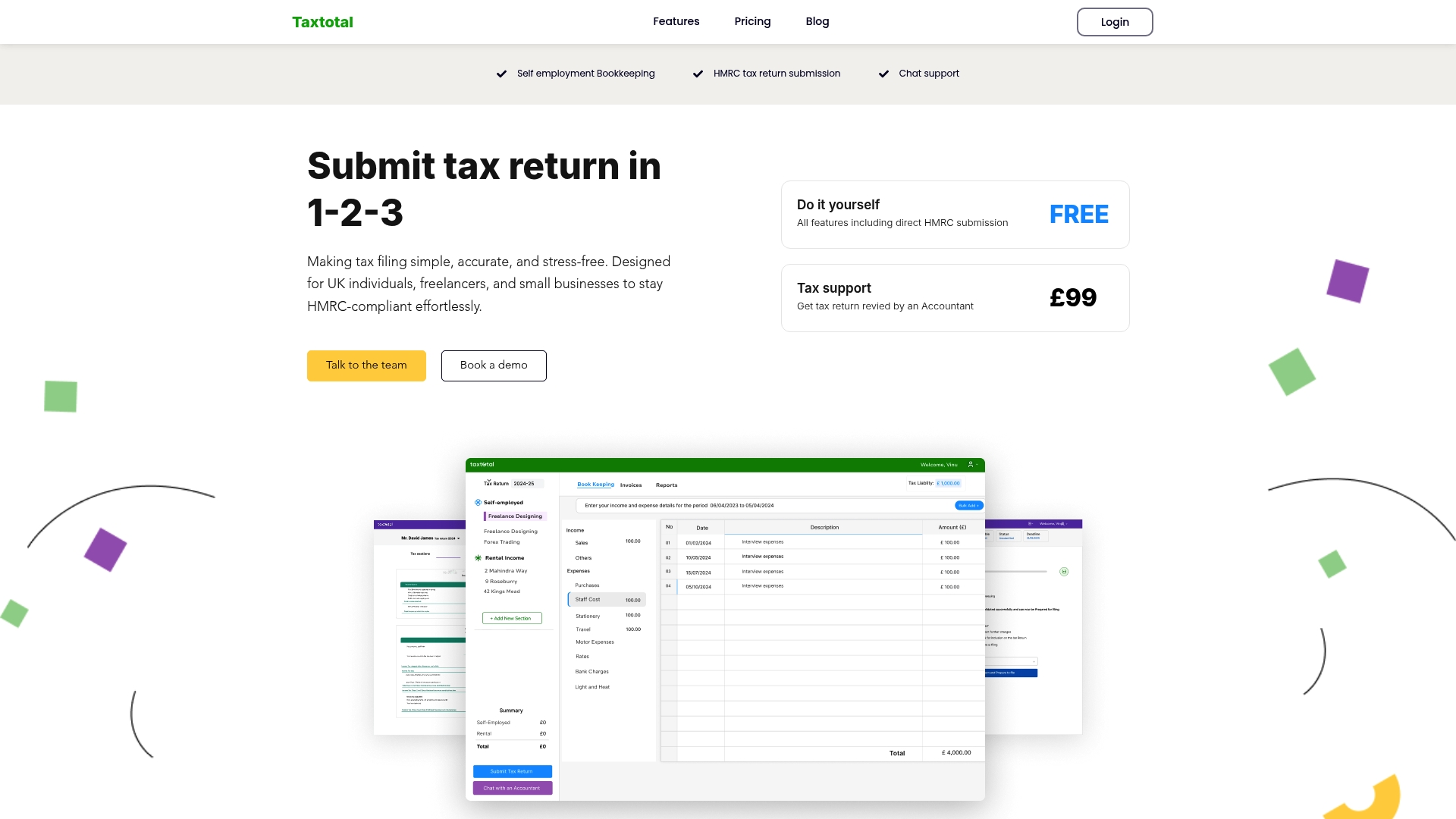
Our platform guides you through every section of your return with plain English questions, automatically calculates your tax liability, and submits directly to HMRC with full error checking. Save hours, eliminate mistakes, and gain peace of mind knowing your submission is complete and accurate. Explore our Self-Employed Tax Guide to understand the complete filing process, or discover how to Prepare Tax Documents with Taxtotal efficiently. Learn more about the detailed HMRC Submission Process and start your return today.
Frequently Asked Questions
What is the deadline for submitting my HMRC Self Assessment tax return?
The deadline is 31 January for online returns and 31 October for paper returns each tax year. Filing by these dates avoids the automatic £100 late penalty.
Can I submit my tax return by sending bookkeeping documents to HMRC?
No, submitting bookkeeping or invoices alone does not fulfill legal filing requirements. You must complete and submit the official Self Assessment return form through HMRC’s online system or by paper.
What happens if I miss the Self Assessment filing deadline?
A fixed £100 penalty applies immediately after the deadline. Further penalties accrue if lateness continues beyond 3 months (£10 daily up to £900), 6 months (£300 or 5% of tax due), and 12 months (another £300 or 5% plus investigation risk). Paying tax due on time does not avoid penalties for late filing, as explained in detail about miss Self Assessment deadline consequences.
Is online submission safer and faster than paper filing?
Yes, online submission is faster, provides immediate confirmation, and reduces errors with built-in validation checks. Paper filing is slower with higher risk of postal delays, loss, and manual mistakes that HMRC won’t catch until processing.